#RESOURCES
Focustribes
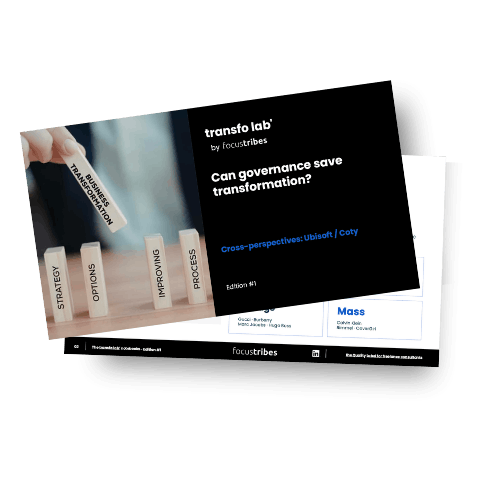
Can governance save the transformation?
A comparison of Ubisoft and Coty
Business transformation – whether digital, organisational or strategic – is becoming an imperative in a constantly evolving environment. However, its success depends largely on the ability to put in place appropriate governance
It was to shed light on this fundamental issue that the first session of TransfoLab took place – an ‘ideas lab’-style workshop bringing together programme directors, transformation managers and operational leaders.
Business transformation – whether digital, organisational or strategic – is becoming an imperative in a constantly evolving environment. However, its success depends largely on the ability to put in place appropriate governance, capable of steering change whilst creating value. In this context, the question arises: can governance save transformation?
In this booklet, you will find a summary of the rich discussions that took place during this evening of knowledge-sharing.
1- The key challenges of transformation: Performance, international agility, the dual human × technological dynamic: now a comprehensive endeavour.
2- Why do our transformations fail? Six systemic flaws: culture, capacity, fragmentation, politics, measurement, preconceptions.
3- How robust governance changes the game: Unity, tight sponsorship, escalation rules, a stable framework — governance as the nervous system.
4- How to organise governance that works: Four concrete pillars: transformation unit + enablers, transformation leads, single source of truth, arbitration rituals.
5- The role of the transformation leader: Doubt, resilience, influence without authority, ethics, emotions, long-term vision, solitude — a tightrope walker.
Read issue #1 of the Transfo Lab notebooks, a summary of the rich discussions that took place during this
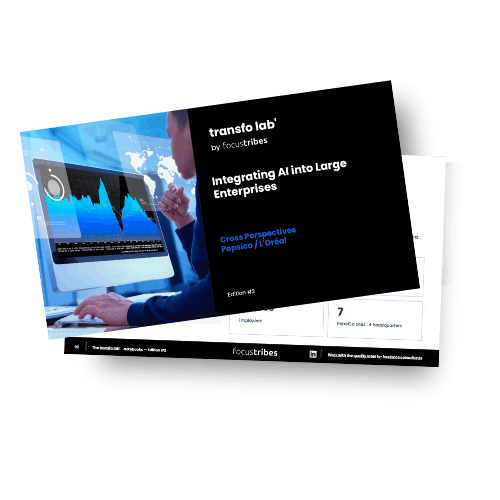
Integrating AI into large organisations: what are the applications, benefits and risks?
Insights and perspectives from L’Oréal and PepsiCo
Behind the hype, a reality is taking hold: AI is no longer just an experiment. It is penetrating the very heart of operations, redefining value chains and transforming business lines — and sometimes even business models.
The second session of the TransfoLab was held to shed light on this transformation.
Artificial intelligence is emerging as a key driver of transformation for large organisations, whether it be to optimise business processes, innovate in products and services, or rethink support functions. However, its adoption raises strategic questions: which use cases deliver the most value? How can real benefits be measured? What obstacles and risks need to be anticipated?
In this report, you will find a summary of the insightful discussions that took place during this evening’s event.
1- AI: a passing fad or a strategic shift? Three levels of AI — commodity, optimisation, disruptive. The real challenge: deciding at which level of maturity to operate.
2- Structuring the organisation through AI: The PepsiCo case study — from debating figures to management via a shared AI forecast. The organisational transformation of the IBP.
3- Regaining control and accelerating innovation: The L’Oréal case: bringing digital creation in-house, shifting molecular R&D from in vitro to in silico.
4- The real conditions for success: Data maturity, collective discipline, human support, redistribution of responsibility.
5- Key points raised: Transformation of business lines, critical thinking, autonomy, energy impact, AI communicating with AI.
Read issue #2 of the Transfo Lab notebooks, a summary of the fruitful discussions that took place during this evening of sharing
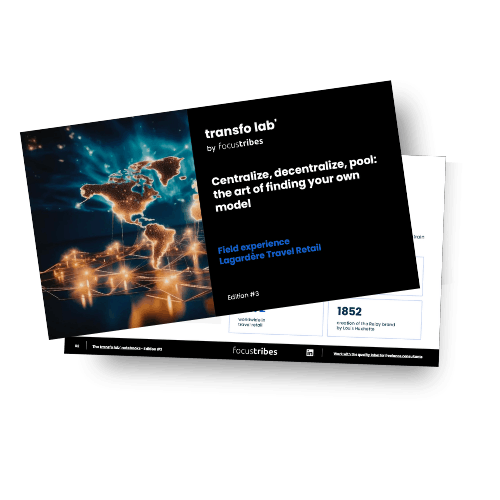
Centralisation, decentralisation, pooling of resources
Challenges, realities and lessons learnt
Lagardère Travel Retail
Centralisation, decentralisation, pooling resources: these trade-offs shape organisations’ costs, efficiency and ability to create value. Yet few have found the right balance — without constantly swinging between two extremes.
The third session of the TransfoLab was held to shed light on these issues.
Organisations are constantly torn between centralisation, decentralisation and the pooling of resources, seeking to optimise costs, efficiency and value creation. Yet these strategic choices give rise to much debate: should we centralise to improve efficiency, or decentralise to gain greater agility? To what extent can resources be pooled without slowing down processes? How can we ensure that simplification does not lead to complexity?
In this booklet, you will find a summary of the insightful discussions that took place during this evening of knowledge-sharing.
1- The perpetual paradox: Why organisations are constantly wavering
2- Centralisation vs decentralisation: The real trade-offs
3- Pooling of resources and GBS: A driver of value or a bureaucratic nightmare?
4- Creating a group: The real objective behind the transformation
5- Changing mindsets: The invisible challenge
Read issue #3 of the Transfo Lab notebooks, a summary of the fruitful discussions that took place during this evening of knowledge-sharing.
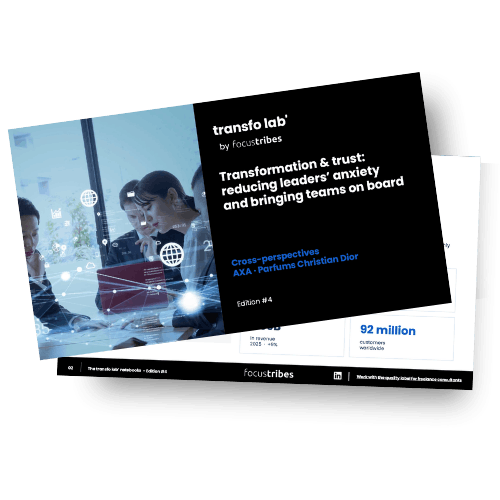
Transformation & trust: reducing managers’ anxiety and getting teams on board
Business transformation often gives rise to anxiety and resistance, among both managers and staff. Yet it can also serve as a catalyst for restoring confidence and mobilising energy. How can these fears be turned into a driving force for change? What role do change management processes and HR involvement play in easing tensions and creating collective momentum?
It was to shed light on these questions that AXA and Parfums Christian Dior came together during the fourth session of the TransfoLab. Two accounts of their experiences, one shared conviction: transformation succeeds when people come first.
In this booklet, you will find a summary of the fruitful discussions that took place during this evening of sharing.
1- The human factor: the blind spot in transformation
2- AXA · The large-scale change programme
3- Dior · The four ‘people’ challenges
4- Dior · The three HR priorities
5- Support from HR and programme directors
Read issue #4 of the Transfo Lab journal, a summary of the fruitful discussions that took place during this evening of knowledge-sharing.
Greenfield S/4HANA Implementation
The Greenfield implementation of SAP S/4HANA signifies far more than a simple technological upgrade; it constitutes a complete re-design of the information system, meticulously crafted to leverage best practices and harness the capabilities of the Cloud.
This approach enables companies to embark on a new beginning with a solid foundation, expedite their digital transformation, and enhance their business processes within a more agile, intelligent, and sustainable framework.
Migrating to SAP S/4HANA represents more than a mere version upgrade; it is a transformative shift. SAP has comprehensively reengineered its ERP system to enhance efficiency, improve usability, and align more effectively with contemporary business requirements.
In this white paper, we discuss :
You can download the webinar ebook below !
How can you turn data into a major asset for your business?
In a world where data has become a strategic lever, data governance is no longer an option, but a necessity. Structuring, securing and leveraging your data assets not only enables you to make better decisions, but also to improve performance, compliance and agility.
Today, data is a strategic asset, just like a product or service. However, without appropriate governance, it can quickly become a source of risk, loss of value and even dysfunction.
In this white paper, we discuss :
You can download the webinar ebook below!
Demystifying AI: Strategies and use cases
Artificial intelligence is no longer a futuristic promise – it’s already here, at the heart of our tools, our businesses and our decisions. Still, with all the surrounding buzz, one question remains: how can generative AI create real value for business ?
Artificial intelligence, which is omnipresent in our daily lives, is no longer limited to tools like ChatGPT. It is profoundly transforming practices, business lines and information systems. Yet many companies are still at the stage of isolated experimentation.
Today, 100% of French people are exposed to AI via Netflix, TikTok, LinkedIn, etc.
Generative AI marks a major turning point in digital content processing and creation technologies. With the democratisation of tools such as ChatGPT and Midjourney, this technology is no longer limited to insiders, but is transforming business processes in real terms, from marketing to software development. Its ability to generate, reformulate and synthesise content makes it an essential lever for innovation and competitiveness in today’s businesses.
In this white paper, we discuss :
International Project Governance : the human touch leads to success
The success of a project depends not only on classic management theories and tools, but also on the human aspect: building the team, relationships with stakeholders, creating a dynamic environment, and motivating individuals to ensure collective success.
You’re maybe already familiar with the ‘official’ theories and tools of project management, but from our experience the success of a project equally relies on the human touch, meaning the set-up of the project team and the link to stakeholders as well as creating momentum and keeping individuals motivated to go the extra mile and feel invested in the success of the project.
Erling and Sophie have summarised the toolkits that they use and have built on some best practices and tips for what works well for them to bring together different profiles on a common transformation path.
In this ebook, we talk about :
You can download the webinar ebook below!
CSRD: How will it change the world?
The Corporate Sustainability Reporting Directive (CSRD) is set to become an essential standard for companies from 2024, completely overhauling their approach to environmental, social and governance (ESG) reporting. Given the complexity of this directive, it can be difficult to know how to prioritise your actions?
The Corporate Sustainability Reporting Directive (CSRD) marks a significant development in the disclosure of environmental, social and governance (ESG) information. Going well beyond the usual rhetoric and statements, the CSRD aims to create deep, structured transparency.
At the heart of the CSRD is ‘dual materiality’. This involves considering and assessing the impact a company has on its environment (impact materiality, inside-out) and the ‘sensitivity’ of its business model to external factors (financial materiality, outside-in).
One of the major challenges in implementing this standard is to define, in collaboration with all stakeholders, which issues are truly material.
In this ebook, we talk about :
You can download the webinar ebook below!
SAP EWM : A powerful solution that requires strong decisions
Do you want to optimise your warehouse processes? Do you need to improve stock visibility and reduce costs? How can you maximise the efficiency of your warehouse management with SAP EWM ? Find out in this replay how SAP EWM (Extended Warehouse Management) can transform the management of your logistics operations.
Complex supply chains and rising customer expectations are creating significant challenges for companies when it comes to warehouse operations. Efficient warehouse management systems (WMS) are essential to minimise costs and increase customer satisfaction. SAP Extended Warehouse Management (EWM) is a solution that meets these growing demands and enables seamless optimisation of warehouse processes.
In this ebook, we talk about :
You can download the webinar ebook below!
CSR: How and where to start ?
With social and environmental issues becoming increasingly present, Corporate Social Responsibility (CSR) is becoming an essential strategic lever for companies. But where to start, and how to reconcile sustainable commitments with return on investment (ROI)?
In this ebook, we talk about :
You can download the webinar ebook below!